Handover
A handover usually happens one morning.
Folder names, passwords, which text dates from which year. And the part that’s never written down: which sentence never worked with which stakeholder, why a word was taken out of a brochure, why the order of a ceremony was changed one year.
For the person taking over, it’s a file. You receive it, open it, get to work.
For the person who put it together, there’s an evening behind every heading. A meeting, a phone call, a paragraph rewritten three times.
Same file. Two different meanings.
Organisations don’t create this asymmetry out of unkindness. It comes from how they’re built. An organisation attaches itself to roles, not people, because a role can be handed over and a person can’t. If every departure were a bereavement, no organisation would last two generations. That’s why an organisation keeps its memory in files, not in feelings.
On the human side, there’s no equivalent. People attach themselves to relationships, not roles. When someone leaves, the organisation fills a function; the person loses a relationship. They part at the same moment, but they don’t lose the same thing.
No profession is more exposed to this asymmetry than communications. Our job, after all, is to create a sense of belonging for others. Whoever writes the sentence explaining why an organisation matters is its first reader. We end up buying the very feeling we produce.
That’s where the real issue begins.
The communicator who identifies completely with the organisation looks like the most loyal person in the building. But they are also the least useful to it. The gap between how an organisation sees itself and how it looks from outside can only be seen from a certain distance. An eye that has merged with the organisation can’t see that gap. It believes the organisation’s story before the organisation does.
This doesn’t show in extraordinary moments, but in ordinary decisions. In the tone of a job advert. In a phrase in a manager’s speech that only means something inside the building. In an announcement that frames good news as the organisation’s achievement alone. Each one small on its own. Together, they become the face the organisation shows the world.
Someone in the room has to be able to say: “That’s true for us, but it won’t read that way outside.” The person who can say that isn’t someone short on loyalty. It’s someone who hasn’t surrendered to the organisation’s view of itself.
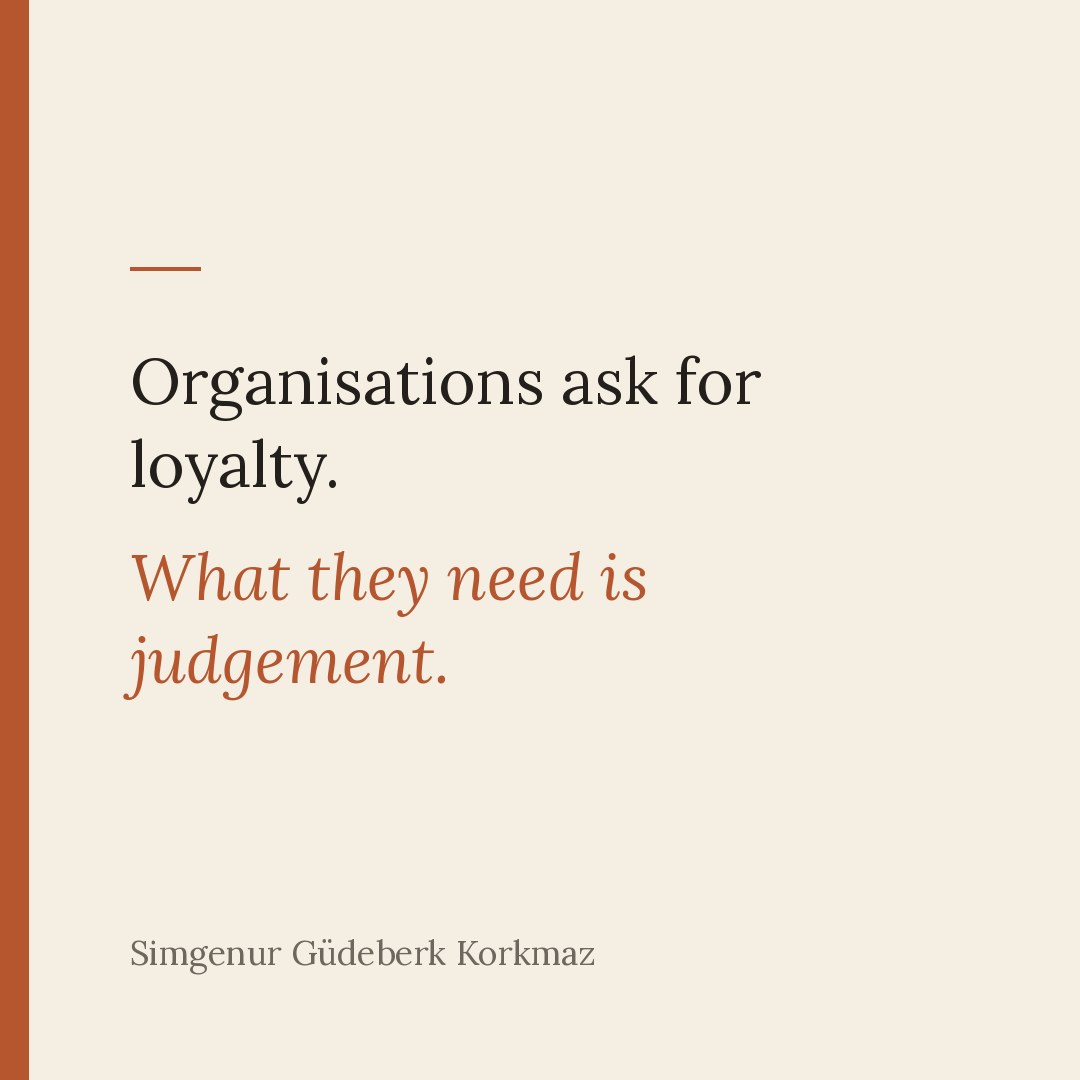
Organisations ask for loyalty, and rightly so. But what they need is judgement. And judgement only survives in people who still have a story of their own.
After nine years, I know this much: what I handed over were files.
What I learned about how an organisation thinks, what it bases its decisions on and how it sees itself isn’t in those files.
That wasn’t handed over.
It’s coming with me.

To talk about your organisation’s communication: simgenurgudeberkkorkmaz@gmail.com